
Tonight made me separate two things recommendation systems often blur together: what a person generally likes and what that same person needs in this particular session. That distinction changed the metric I cared about from a click to a satisfied session.
THE SIGNAL
Streaming services have become very good at putting enormous catalogs in front of us.
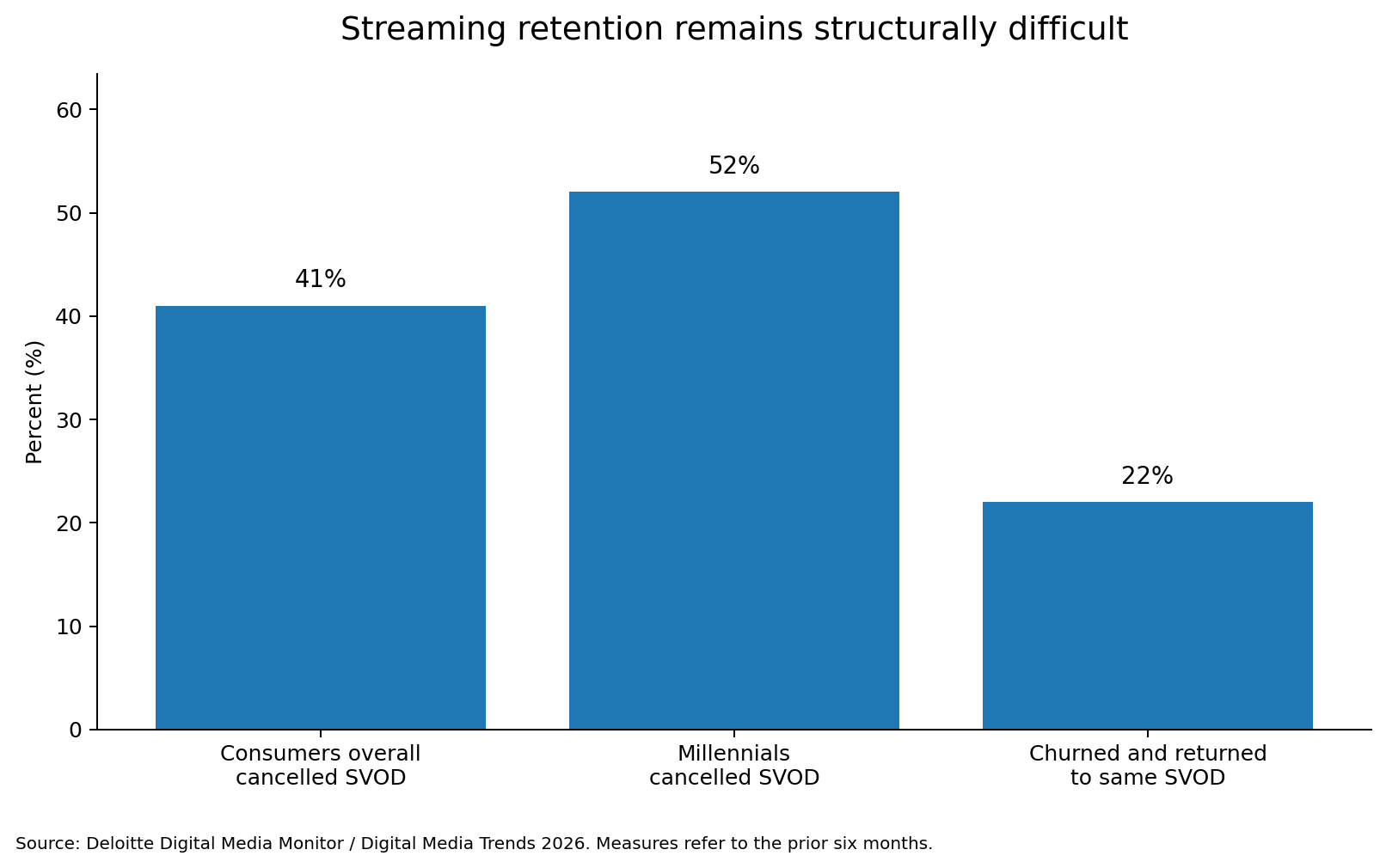
Retention is still difficult.
Deloitte’s 2026 Digital Media Trends reports that 90% of US households have a paid SVOD service, with an average of four services. Its Digital Media Monitor reports that 41% of consumers cancelled an SVOD service in the prior six months, rising to 52% among millennials. Twenty-two percent cancelled and later returned to the same service in that same six-month window.
Those statistics do not prove that recommendation quality causes churn.
But they do tell me something important: access to content alone is not enough to guarantee perceived value.
THE QUESTION
What should a recommender optimize?
Clicks?
Play starts?
Watch time?
Completion?
Return rate?
Every choice changes the product.
If I optimize only “probability of starting,” I may learn that familiar, highly popular content wins.
If I optimize only watch time, I may over-reward long content.
If I optimize only immediate engagement, I can slowly reduce discovery diversity.
THE TENSION
The user has at least two different preference systems:
Persistent preference — what I usually like.
Session intent — what I need right now.
At 11:20 PM with 35 minutes before sleep, I am not necessarily the same viewer I was on Saturday afternoon.
That creates a product objective that is more interesting than “personalize the homepage.”
I would model recommendation quality as something like:
Session fit × taste fit × eligibility × novelty × confidence − decision effort
The exact weights are an experiment—not a truth.
MY PRODUCT TAKE
I would introduce a metric I call Satisfied Session Rate.
A satisfied session is not merely a click.
It could combine:
- user starts a title without excessive browsing;
- title fits stated/derived session constraints;
- user does not abandon immediately;
- user gives a lightweight positive signal or behavior consistent with satisfaction;
- long-term retention/diversity guardrails remain healthy.
The point is not that this formula is universally correct.
The point is to move the conversation from:
“Did they click?”
to:
“Did the recommendation make this session better?”
Deloitte’s 2026 study also found that 22% of fans said they would use streaming services more if gen AI produced better personalized recommendations. I would treat that as evidence of interest—not proof that an AI recommender automatically improves retention.
WHAT I WOULD TEST
I would run three treatments:
Control: existing recommendation experience.
Treatment A: explicit session intent — time available, company, energy, novelty.
Treatment B: inferred context — time/device/history — with optional user correction.
Primary metric:
Satisfied Session Rate
Guardrails:
- time-to-play;
- early abandonment;
- recommendation diversity;
- rights/maturity violations;
- long-term return behavior.
A treatment that increases play starts but increases abandonment should not be celebrated.
WHAT WOULD CHANGE MY MIND
If passive behavioral signals produce equal or better satisfaction than asking for session context, I would remove the additional interaction.
The best personalization experience may be invisible.
But the product objective still needs to be explicit.
Secondary research
- Deloitte Digital Media Trends 2026 — https://www.deloitte.com/us/en/insights/industry/technology/digital-media-trends-consumption-habits-survey.html
- Deloitte Digital Media Monitor — https://www.deloitte.com/us/en/insights/industry/technology/digital-media-trends-consumption-habits-survey/digital-media-monitor-dashboard.html