
Threadline came from a product question I keep returning to: when information is effectively infinite, should discovery help me consume more — or help me decide what is not worth my attention? I think the second job is becoming more valuable.
THE SIGNAL
The internet solved access.
It did not solve prioritization.
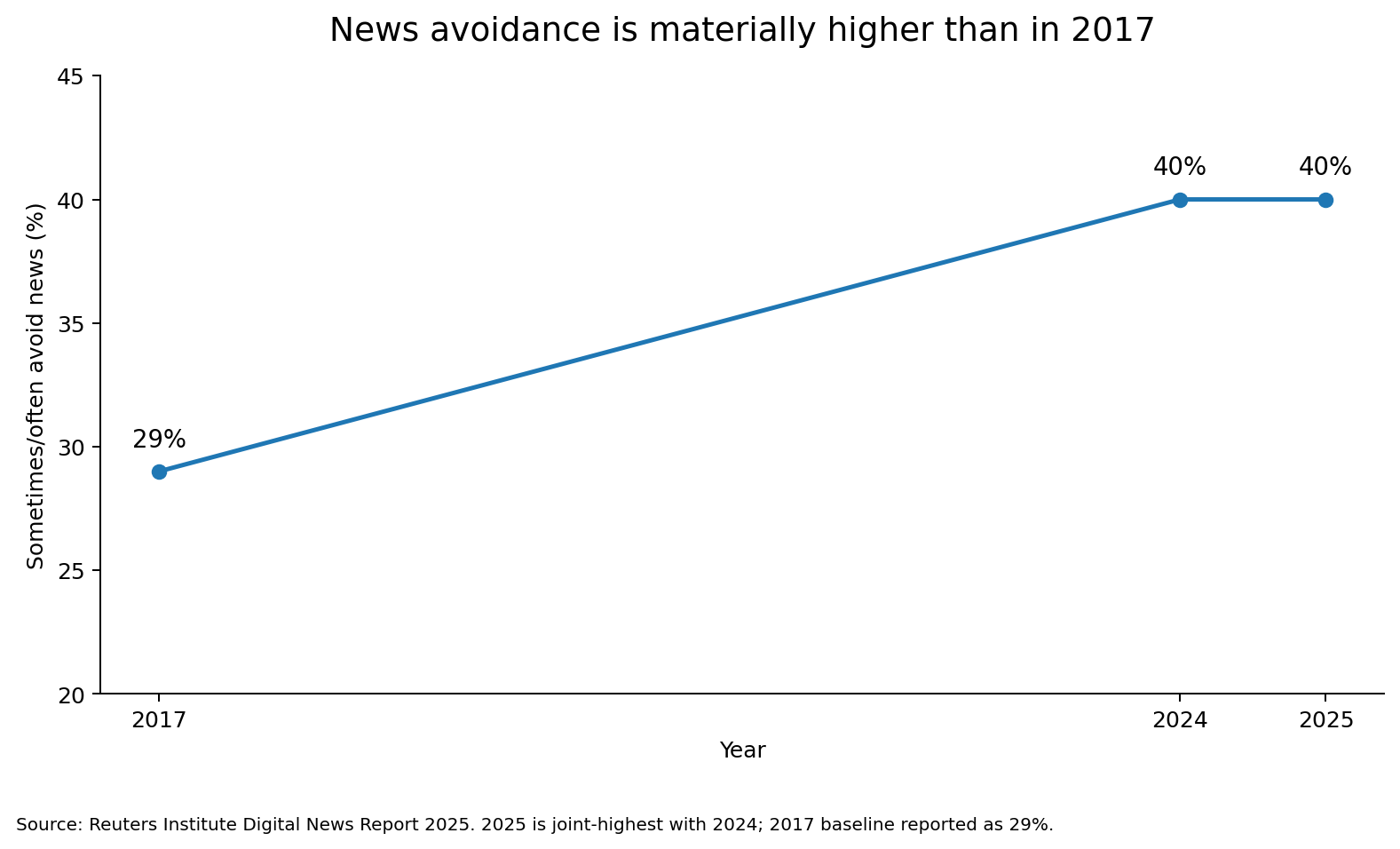
Reuters Institute’s 2025 Digital News Report found that 40% across surveyed markets said they sometimes or often avoid news, up from 29% in 2017 and tied with 2024 for the highest recorded level in the series.
News is not the same thing as professional long-form research, and I would not pretend this statistic validates a product for knowledge workers.
But Reuters’ work gives us a useful behavioral signal: more available information does not automatically create more engagement. Overload can create avoidance.
Its separate research on notifications shows a similar tension. Publishers use alerts to build habit and direct relationships, yet consumers can become overwhelmed enough to disable them.
THE QUESTION
What if a discovery product’s job is not to maximize the number of things you open?
What if its job is to tell you:
“These four things are worth your limited attention. The other forty probably are not.”
That changes the ranking objective.
THE OBVIOUS ANSWER
Most feeds rank for some combination of relevance, freshness, popularity and engagement probability.
Those are reasonable features.
But relevance alone creates repetition.
Freshness alone rewards novelty without insight.
Popularity creates concentration.
Click probability can reward provocative packaging rather than intellectual value.
THE TENSION
For a knowledge worker, I would rank on a different objective:
Relevance × expected information gain × trust × novelty × diversity − attention cost
Again, that is a product hypothesis, not an empirical formula.
The unusual term is information gain.
An article can be highly relevant and still add nothing.
If I have already read six versions of the same argument, the seventh may deserve a lower rank even if it is excellent.
A contradictory piece may deserve a higher rank because it changes the shape of my understanding.
MY PRODUCT TAKE
I would make the persistent object an idea thread, not a feed.
The system should know:
- what claims the reader has seen;
- which evidence supports them;
- where credible sources disagree;
- which new item adds something genuinely different;
- which source is being overrepresented.
Then each recommended read can answer:
Why is this worth my time?
Not “Because it matches your interests.”
But:
“This introduces evidence you have not seen.”
“This contradicts a claim in two saved pieces.”
“This is the strongest primary source behind an argument you have only read second-hand.”
That is a more useful product contract.
WHAT I WOULD TEST
I would compare:
relevance-only ranking
vs
relevance + diversity
vs
relevance + information-gain ranking
and measure:
- qualified read rate;
- original-source opens;
- save-to-read conversion;
- dismiss rate;
- source concentration;
- repeat thread return;
- whether the queue gets smaller over time.
The anti-metric matters too:
If users read only the AI preview and stop visiting creators, the product may be destroying the ecosystem it depends on.
WHAT WOULD CHANGE MY MIND
If users consistently prefer a conventional chronological/relevance feed and do not value “what this adds,” I would simplify.
But I would still keep one principle:
A discovery system should optimize scarce attention, not infinite inventory.
Secondary research
- Reuters Institute, Digital News Report 2025 — https://reutersinstitute.politics.ox.ac.uk/digital-news-report/2025/dnr-executive-summary
- Reuters Institute, notification overload — https://reutersinstitute.politics.ox.ac.uk/digital-news-report/2025/walking-notification-tightrope-how-engage-audiences-while-avoiding